
Early fall is a great time to re-evaluate your spring-blooming perennials. Yes, you read that right! Christina and I expect double duty from those early season flowers with exceptional foliage that still adds color, structure, and interest at least through until the end of fall. That is especially important in small gardens where there is nowhere to hide and every mediocre leaf is right there in front of you.
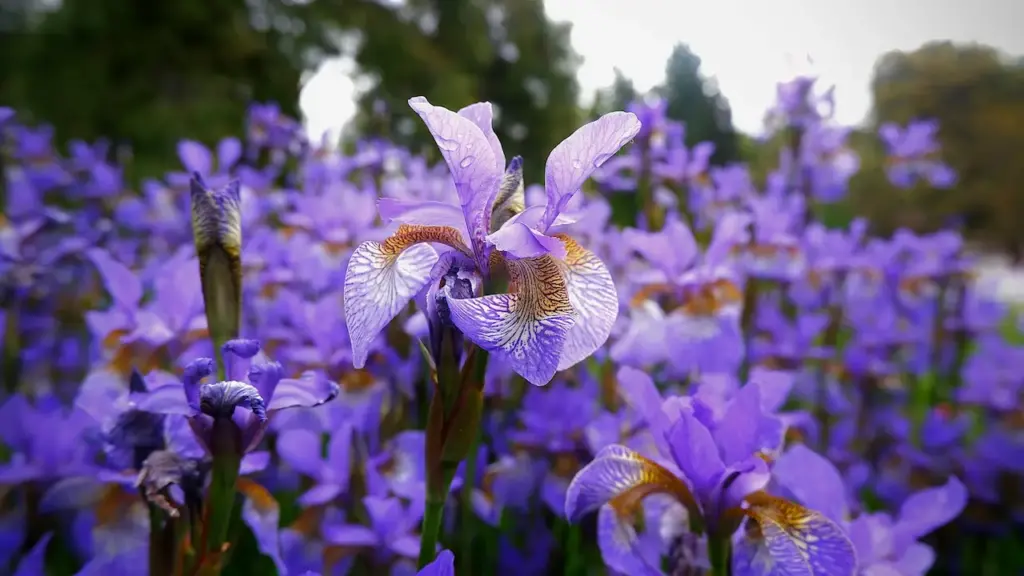
A traditional favorite for the spring garden is the iris, grown primarily for cut flowers. There are many species to choose from from the large bearded varieties available in a rainbow of colors too tightly packed clumps of cobalt blue Japanese iris and dwarf forms suitable for the rockery but my go-to is the variegated sweet iris. There are two forms available with either a creamy-white (Iris pallida ‘Alba-variegata’) or a soft yellow variegation (Iris pallida Aureo-variegata’) – and they look stunning right now.
Stiff fans of striped foliage multiply steadily into clumps 2′ tall and wide making it a perfect addition to the front of the border while the soft color lends itself to many different combinations.
Playing with Yellow
In the stunning border above, the iris has been used to add contrast to the chocolate leaves of Bishop of York dahlia while echoing the sunny yellow flowers. Yellow-toned variegated purple moor grass (Molinia caerulea subsp. caerulea ‘Variegata’) and a golden Japanese forest grass (Hakonechloa macra ) add fine texture while an overhead canopy of a variegated aralia (Aralia elata ‘Aureo-variegata’) emphasizes the theme and frames the vignette. Taken in August, the iris have long since finished blooming but their foliage clearly continues to add drama. You can see more from this garden in our new book due out in the fall of 2016 with Timber Press.
Crisp and White
For a different look use the long-blooming Rozanne cranesbill (Geranium ‘Rozanne) to weave through a green and white variegated iris, adding a dwarf dark leaved weigela (e.g. Weigela florida ‘Midnight Wine’) for contrast.
I have also used the green and white variegated form to create a pretty monochromatic scheme with green and white hosta or the silver/green Jack Frost Siberian bugloss (Brunnera macrophylla ‘Jack Frost’).
Flowers – the Icing on the Foliage
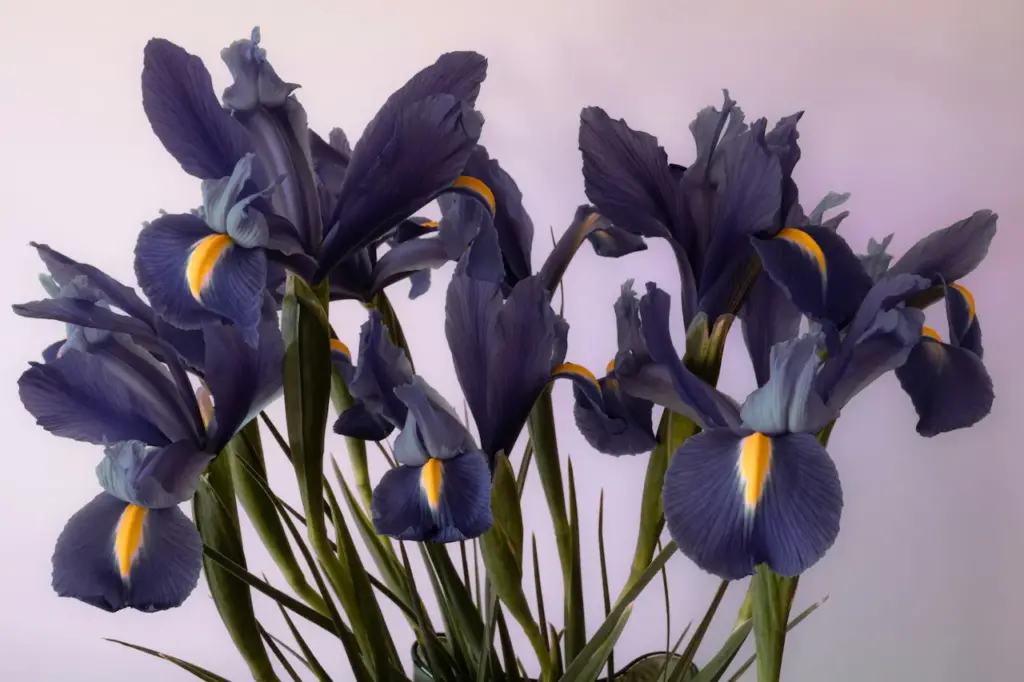
In May and June, dozens of exquisite papery periwinkle-blue flowers appear on stiff stalks 2′ above the foliage, filling the air with a delicate scent. Consider this color when selecting companion plants. In the examples shown above these flowers will repeat or enhance the color scheme of the surrounding shrubs and perennials.